
Not so “Happy” returns? Sort yours out before the holidays.
September 24, 2026
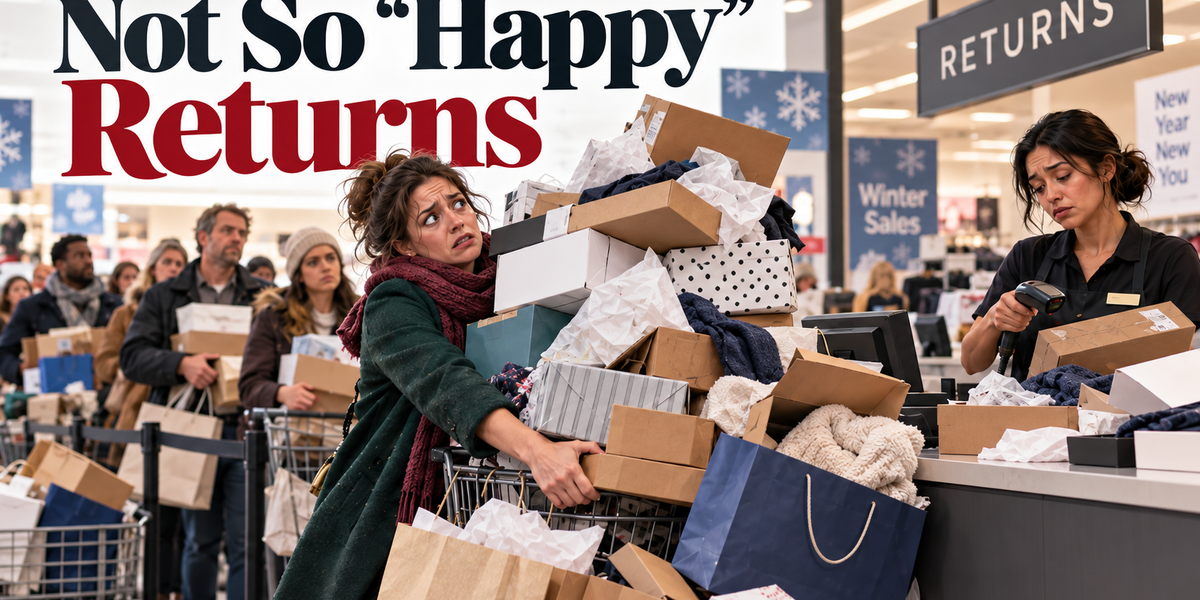
$849.9 billion. That's how much stuff the National Retail Federation expected US shoppers to send back in 2025. It works out to almost 16% of annual retail sales.
A totally normal amount of merchandise to return.
Wondering how much of that applies to you? Here’s the methodology, and what it can actually tell a small business.
Who produced it, and what they sell
NRF did the research with Happy Returns and published it on October 15, 2025. The fieldwork ran in summer 2025, so the data is about 15 months old. By retail research standards, that's fresh.
Two surveys sit underneath it. One asked 2,006 consumers who had returned at least 1 online purchase in the previous 12 months. The other asked 358 ecommerce professionals at US merchants with more than $500 million in revenue.
So, your peer group. If your business clears $500 million, congratulations, and you can stop reading.
Still here? 3 things about that sample matter.
The retailer half is big companies (think, Target, Nordstrom, etc). When they describe how they handle returns, they're describing warehouses and staff.
Happy Returns is a UPS company that sells returns logistics. The returns company studied returns and found that returns are expensive and complicated. I mean, yeah, we know this.
Consumer surveys measure what people say they did. Nobody has ever filled out a survey and made themselves look worse.
The consumer half does apply to you, unfortunately. Your customers learned what to expect from Amazon and Target, and they will not be adjusting those expectations because you have 4 employees.
The figures worth carrying around
- 19.3% of online sales were expected to be returned in 2025.
- 17% of holiday-season sales were expected to come back.
- 9% of all returns were estimated to be fraudulent.
- 82% of consumers said free returns are an important consideration when shopping online.
- 76% said they'd prefer an instant refund or exchange.
- 71% said they're less likely to buy again after a bad returns experience.
That last one is the expensive one. Everything above it costs you once.
A customer who stops buying keeps costing you for years. I know plenty of business owners that loathe returns, thinking they are being scammed every time or that it’s going to eat into their profits. While the latter is true, that part is very short term. (This doesn’t excuse the 5% of people that truly do take advantage).
More like this, weekly.
One email a week on operations, systems and where AI actually helps.
What to do about it before December
Write the policy down and put it where people buy. Put it on the product page, in plain words: how many days, who pays return shipping, refund or store credit, how long the refund takes. A lot of small-business return policies currently live in the owner's head, and customers find that location very hard to read.
Decide your holiday return window now. Anything bought in late November gets wrapped, opened on December 25, and lands in your inbox on December 26. Pick the date you'll honor, publish it, and skip the part where you negotiate with strangers at 9pm on December 27.
Track the reason, every time. 5 reason codes is enough: wrong size, not as described, damaged, changed mind, arrived late. 2 months of that data tells you whether you have a returns problem or a product-page problem.
One bad photo or a missing measurement can generate returns for a year. Nobody notices, because nobody reads their own product page.
Answer return requests within 1 business day. Amazon refunds instantly. You have a laptop and 1 business day, so use the business day.
Put a restocking rule in writing before you need one. Decide what condition earns a full refund and what earns a partial one. Then apply it the same way to everyone, including the customer who sends 4 paragraphs about it.
Reconcile returns against the bank, monthly. A refund issued and never reconciled is how a business finds out in March that its 2026 revenue number was a lovely piece of fiction.
One caution on the 15.8%
That figure is a share of total US retail sales, and most of those sales run through very large companies. Your own return rate is the one that hits your margin, and it could sit well above or well below 15.8% depending on what you sell.
Apparel and footwear come back constantly. Consumables and custom work barely come back at all. Very few people return a sandwich.
Use the national number as a reason to look. Use your own number to make decisions.
Don't know your own number yet? Neither do most people. Fix it anyway. It's one afternoon in whatever system takes your orders.
The free part
3 of those 6 steps are writing something down and then doing what you wrote. No software, no budget, no 45-minute vendor demo.
An afternoon in October covers it. October is the last month you'll have a spare afternoon, so enjoy it while it lasts.
Tracking reason codes is a spreadsheet with 5 columns. If you want more than a spreadsheet, AI can read 2 months of return notes and tell you which product keeps coming back, so you don't have to read them yourself. That's what we build in my workshops, with your own data instead of a cheerful demo. Dates are at luma.com/user/usr-yNP17hArZ18OZlc.
Source: NRF and Happy Returns, 2025 Retail Returns Landscape, published October 15, 2025, with NRF's accompanying release. Consumer survey n=2,006; retailer survey n=358 at merchants over $500 million in revenue; fieldwork summer 2025. Happy Returns is a UPS company and sells returns logistics.
More like this, weekly.
One email a week on operations, systems and where AI actually helps.