AI Slop Is Everywhere. And It’s Starting to All Look the Same.
August 30, 2026
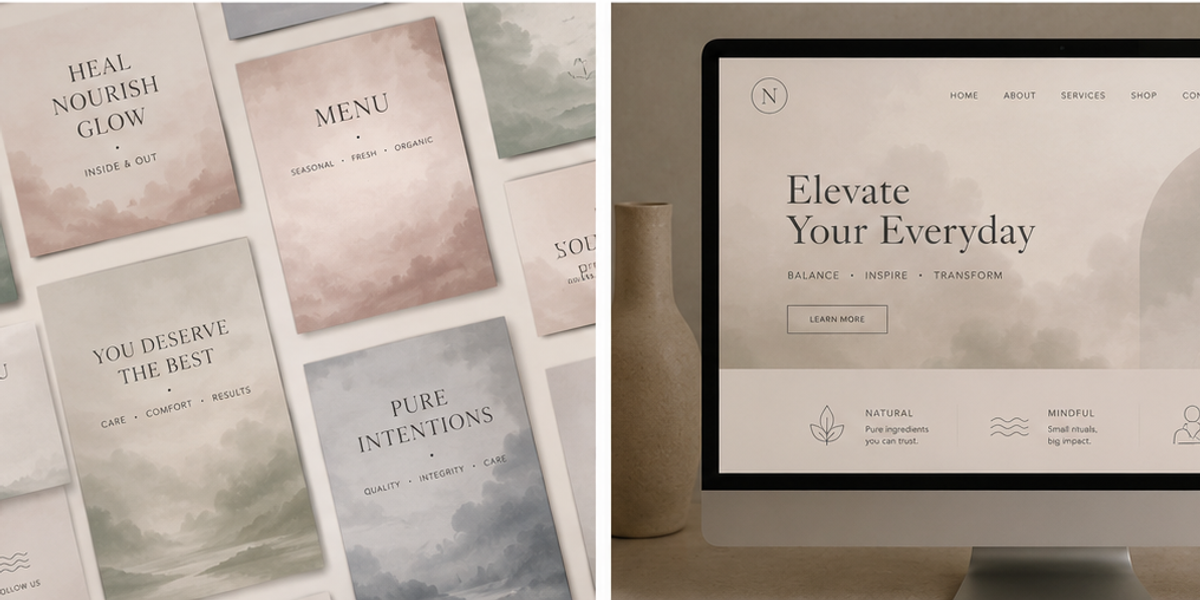
I see it everywhere now.
At hotels. At my esthetician’s office. At the doctor’s office. On menus, flyers, event signage, social graphics, websites, brochures, presentation decks. I see it locally, I see it overseas, and increasingly, I can almost tell when something was designed entirely by AI before I’ve even read a word on the page.
It’s not necessarily bad. That’s actually part of the problem.
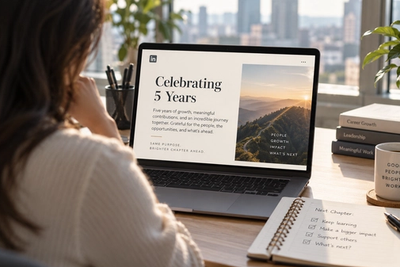
It’s clean. It’s polished enough. It’s modern. It uses decent fonts. The spacing is usually pretty good. There are a few minimal line icons floating around. Maybe there’s a tiny dot between two phrases. Maybe there’s an abstract cloudy gradient in the background. Or there’s a translucent box over a soft beige, blue, peach or lavender shape. And somehow, despite being created by completely different businesses in completely different industries, it all looks strangely familiar.
That is AI slop in design.
And I don’t mean “slop” because every AI-generated design is ugly. A lot of it is perfectly fine. I mean it because we are creating an enormous volume of content that is technically acceptable, instantly recognizable, and completely forgettable.
AI has learned what “good modern design” looks like by absorbing an unbelievable amount of existing work. So when you ask it to create a luxury spa flyer, a sophisticated restaurant menu, a consulting website, a wellness brand, a business presentation or a social post, it tends to gravitate toward the same visual language over and over again. Clean sans-serif fonts. Oversized headlines. Tiny secondary type. Soft gradients. Rounded boxes. Minimal icons. Lots of white space. A little sparkle icon somewhere for good measure.
Once you start noticing it, you cannot stop noticing it.
The irony is that businesses are often using AI because they want their marketing to look more professional. And for a while, it does. Especially if the alternative was something thrown together in five minutes with no design experience at all. AI has dramatically raised the floor. Almost anyone can now create something that looks reasonably polished.
But raising the floor is not the same thing as raising the ceiling.
When everyone has access to the same tools, the same templates, the same prompts and the same visual patterns, taste becomes more important, not less. Creative direction becomes more important. A point of view becomes more important. Knowing when something feels too generic becomes more important.
This is exactly why I do not believe graphic designers are going anywhere.
If anything, the best designers become more valuable in an AI-heavy world. A designer is not valuable because they know how to place text inside a rectangle or choose a font. They are valuable because they can look at a brand and understand what it should feel like. They can create tension, personality, restraint, humor, weirdness, warmth, sophistication or surprise. They know when breaking a design rule is what makes the design work.
AI is very good at giving you what already exists. A creative person is good at deciding what should exist next.
That distinction matters.
I use AI constantly. I think it is one of the most powerful tools we have been given, and I absolutely think businesses should use it to move faster, generate ideas, create drafts, explore visual directions and reduce the amount of repetitive work involved in marketing. But there is a big difference between using AI as part of the creative process and asking AI to become your entire creative department because you want to save money.
That shortcut is becoming visible.
Your customers may not consciously say, “This looks AI-generated.” But they may feel that your brand looks generic. They may scroll past it because nothing stops them. They may have seen essentially the same design from a dentist, a hotel, a med spa, a software company and a restaurant in the same week.
That is not branding.
Branding is supposed to create recognition. It is supposed to make someone know something came from you before they even see your logo. If your marketing materials could belong to almost any company in almost any industry, they are not really doing their job.
The answer is also not to stop using AI.
Use AI to brainstorm. Use it to make rough layouts. Use it to create moodboards. Use it to help you articulate what you like and what you don’t. Use it to speed up production. Use it to resize things, clean things up, generate variations and help you get unstuck.
Then bring a human eye back into the process.
Change the spacing. Question the layout. Remove the unnecessary icons. Stop putting a sparkle next to every mention of AI. (Wait, I kind of like that sparkle though…) Pick a visual direction that actually connects to your brand instead of whatever style is currently circulating through every AI design tool. Hire a graphic designer when the work matters. Let someone with taste tell you when the first version is fine but completely forgettable.
AI can make design cheaper.
It can make design faster.
It can make design more accessible.
But it cannot make every business interesting.
That part still requires a person…and maybe a little sparkle. :)
More like this, weekly.
One email a week on operations, systems and where AI actually helps.